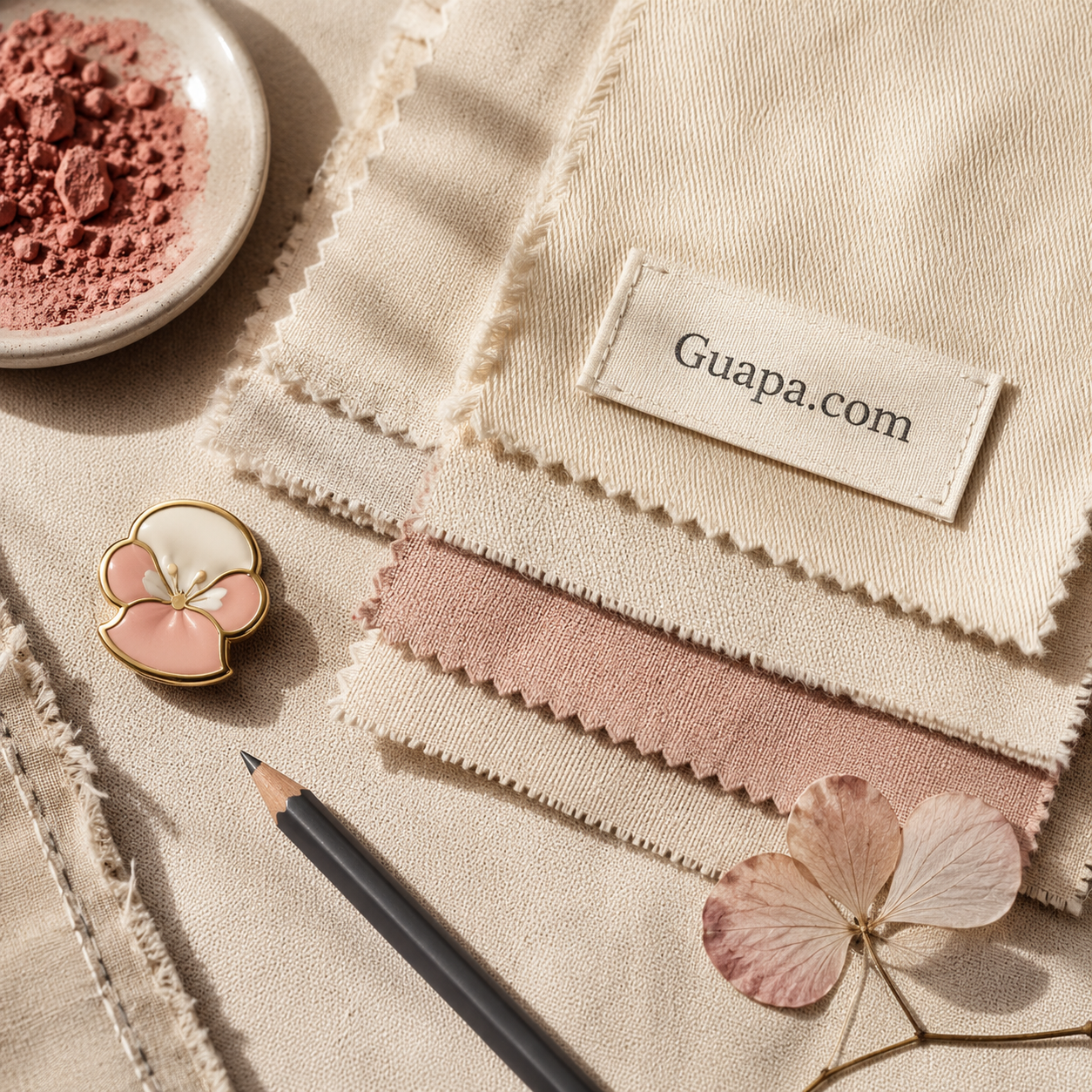
Guapa.com works as a fashion house name for a clothing or accessories brand that can wear a Spanish word for pretty as the parent mark. Guapa already means pretty, or beautiful, in Spanish. A house name has to hold more than the first drop. It sits above seasons, collaborations, retail rooms, and years of reputation. The best ones sound complete before the lookbook is explained. Guapa has that compact presence, and it has a dictionary warmth English compounds have to strain for. The matching .com gives the pretty word a permanent front door.
The useful founder for this direction expects the collection to move. The first line may be narrow: knitwear, small leather goods, jewelry, or a focused ready-to-wear capsule. The central name should still make sense when a second line arrives. Guapa does not name a fabric, a city, or a category. It names a feeling people already know. Expansion can keep the same public word because pretty travels across seasons more honestly than a long descriptive label. That balance shows up in the strategic naming work at Interbrand, where the verbal identity is treated as part of a larger business system rather than a slogan taped to a launch deck.
A mark above the season
A fashion house should create coherence. Products can have their own titles, colors, and audiences while the parent mark provides confidence and recognition. Guapa could appear quietly as an endorsement on a hangtag, or it could take the leading role on the masthead. Decide that architecture early, because it affects every URL, lookbook credit, invoice, and announcement that follows. A hangtag that says Guapa is already saying something kind. The collection then has to earn that kindness.
The word also carries enough quiet tension to invite a strong visual response. A restrained serif could make it feel established. A blunt sans could make it immediate. The point is not to decorate five letters. The point is to choose a voice that suits the house. Studios such as Landor show how naming and identity choices have to support an organization across many encounters, not only a homepage hero. Guapa helps that work because Spanish already supplied the mood. Design can answer the meaning instead of inventing one.
Write a short house rule while the company is still small. Record the preferred capitalization, the spoken stress, the domain, and a one-line description that can sit under the name without becoming a second brand. House names fail in the details: a team starts hyphenating, a designer stacks a category word beside the mark, a product team publishes a nickname that sticks better than the parent. A Spanish dictionary word survives those pressures if the people using it treat it as the institution, not as decoration. Pretty is already in the letters. The house still has to behave like it.
What operating experience changed
The company I helped build climbed toward exact-match Newswire.com: the right domain for the Newswire name and for the category itself. The path ran through i-Newswire.com in 2007, then iNewswire.com, then Newswire.com. Each step was about cleaner speech and the public address the market already expected, not a rename for its own sake. Guapa.com asks for the same class of decision. Guapa is a Spanish dictionary word for pretty. Owning the matching .com is fighting up to the right mark for a fashion house the way that climb fought up to the category word. A hyphen or a near-match still costs correction on every call. The exact mark lets the conversation move toward the collection.
That history is why a house name needs tests beyond the launch page. Hear it in a buyer introduction. See it on an invoice. Check whether a stylist can say it with confidence and whether a customer can remember it later. The broad identity work of Wolff Olins offers useful examples of marks that become operating language. Pentagram shows how a concise verbal idea can support many visual expressions without needing a new name for each chapter.
Guapa passes those ordinary tests more readily than a long descriptive phrase. Two beats. Five letters. A real Spanish word, so a listener who knows the language already has the meaning, and a listener who does not can still keep the sound. A typist can find it. The .com ending stays familiar when someone says the full address at the end of a sentence. For a house that expects to live in email, press, packaging, and speech, that compactness is not a style choice. It is an operating advantage, with beauty already sitting in the name.
What to build around it
Do not pretend the house already exists. Start with a real first offer, a clear audience, and a parent mark that can endorse later work. The first product might keep its own name. Guapa would sit above it as the institution that stands behind the work, and as a Spanish compliment the house is willing to live up to. Over time, if the company earns trust, customers may start using the house name as shorthand for the whole experience. That is the prize of this direction: one warm word, already meaning pretty, that can gather several efforts without sounding like a holding-company serial number.
Visual identity should stay patient. A house does not need ten decorative systems in year one. Choose a type voice, a compact color set, and a rule for how the name appears on a card, a site tab, and a hangtag. Then keep those decisions while the catalog grows. The name is short enough that over-designing it will only add noise. Let the work earn the pretty the word already promises.
Retail and wholesale both put pressure on the spoken mark. A buyer on a showroom floor will repeat Guapa into a phone. A customer in a fitting room will ask for it by name. A press contact will type it from memory after a short conversation. Those moments are where a Romance-language dictionary word earns its keep. Category phrases and founder surnames both create friction there. Guapa stays light enough to survive them.
This direction fits a team with a defined point of view and several possible products ahead. The company should be willing to make meaning through conduct, because Guapa supplies a Spanish sense of beauty rather than a category explanation. With a clear offer and consistent voice, the name can become the word customers use for the whole institution. That is the fashion house possibility on Guapa.com: a dictionary word for pretty, waiting for a house that can live up to it.